
Protecting land and farmers: better conditions for resilient chili and seed spice farming in India

Across Andhra Pradesh, Telangana, Karnataka, and Rajasthan, farmers are moving beyond monoculture - shifting their fields into diverse, nature-supported ecosystems that work with the land, not against it. Over the past two seasons (2023-24 & 2024-25), ofi and Nestlé, under Nestlé’s Responsible Sourcing Program, are working together to transform India's chili and seed spice belts.
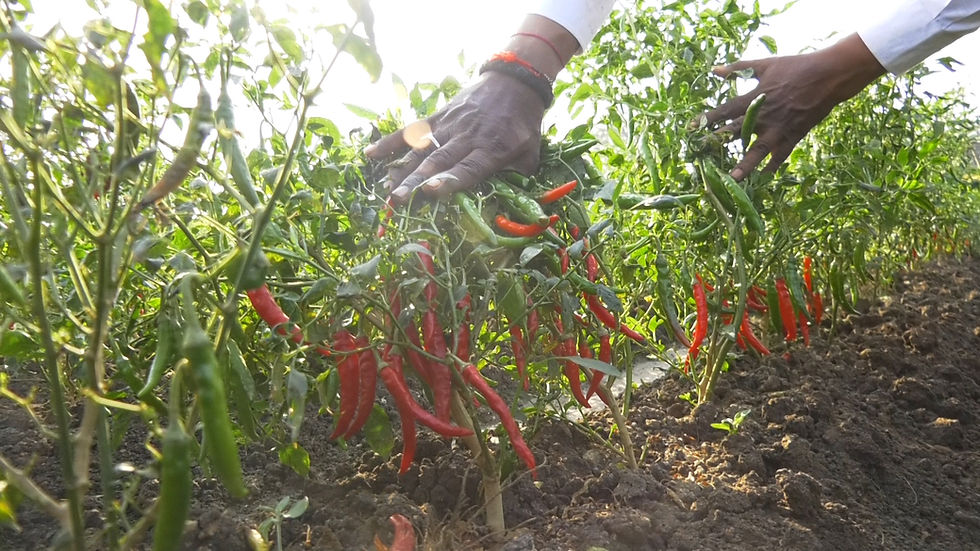
These biodiversity plots combine intercrops that enrich the soil, trap crops that lure pests away from chili, and border crops that form natural barriers. By preserving natural predators, the pest-defender ratio shifts in favor of the crop. This reduces the need for chemical sprays, proving Integrated Pest Management is both a practical and affordable nature-based solution.
The changes are visible: organic soil matter increases, earthworm activity thrives, and farm productivity rises as the land becomes a more stable, diverse habitat. The benefits extend beyond ecology as intercrops provide chemical-free food for farmers' families.
As Sampath Rao Sirikonda, farmer from the village of Gudeppally, Telangana puts it: "When we give life to a farm, the farm gives more life back to us." This shift toward biodiversity is helping farmers build healthier soils, reduce risk, and grow spices in a way that’s better for the environment.
Reducing risks for farmers and their crops
Across India's key spice-growing regions, extreme heat can damage both the health of farmers and their crops. Global ingredient supplier ofi is also helping farmers protect workers health and crop quality, reducing post-harvest losses with shade nets and tarpaulins for 862 farmers and avoiding heat exhaustion with bamboo hats for 1,400 workers handling chilli drying.
Another key aspect to ensure health in such conditions is the provision of clean drinking water. Because of this, the intervention in the cumin and coriander-producing regions of Rajasthan also included the installation of five water coolers and one reverse osmosis (RO) water plant, providing clean water to 600 villagers and 1,000 school children.
Advancing farm mechanization
To boost productivity and incomes, ofi is also supporting mechanization with power sprayers and a drone, benefiting 410 farmers and helping them adopt more efficient, sustainable practices.
“Together with Nestlé, ofi is committed to deliver long-lasting impact helping farmers to improve their livelihoods, making them more likely to adopt regenerative agricultural practices, as we believe stronger communities build more resilient supply chains” explained Sreedhar Kaluva, Head of Sustainability and Procurement - India Spices, ofi


Comments