
What We Learned in Gaitania: How Community Monitoring Is Changing Coffee Farming in Tolima
An episode of Agrotalk recorded in the field, with the voices of the people building CMAS every day
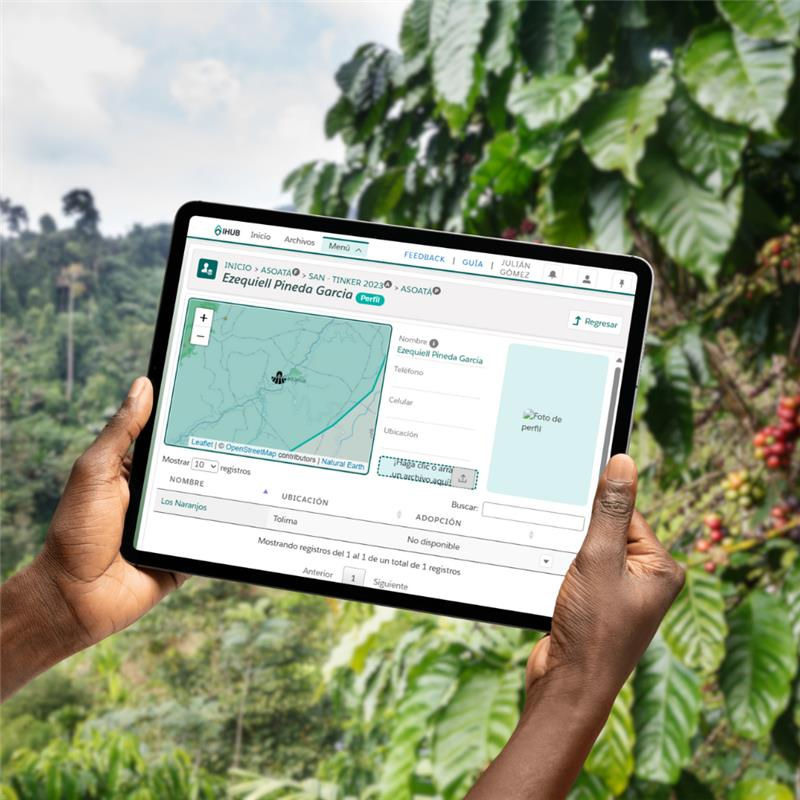
Some projects are best understood in a meeting room. Others can only truly be understood while walking through coffee fields. CMAS — the Community-based Monitoring and Assurance System — clearly belongs to the second group. That's why, for this episode of Agrotalk, we didn't record in a studio: we went to Gaitania, in the coffee heartland of Tolima, where for a week we visited associations, talked with coffee farmers and producers, and spoke with the community monitors who apply this methodology directly in the field.

To close out that week, we brought together four people central to CMAS's development: Oliver Bach and Julián Gómez, project leads from the SAN Secretariat; Andrés Rueda, Head of the Participatory Climate Monitoring Project at Fundación Natura, a SAN Member organization; and Sebastián Arrieta, Coffee Commodity Lead at Preferred by Nature, another Member organization of our network.
The question guiding the conversation was simple, but not obvious: can a monitoring system built and operated by the community itself be as rigorous as an external one, while also driving real change in producer practices and better market opportunities?
Here's what we found.
A Monitoring System That Doesn't Replace the Auditor — It Talks to Them
The first clarification Oliver and Julián made is worth repeating: CMAS isn't designed to replace traditional third-party certification audits. It complements them.
As Oliver explained, smallholder producers and coffee associations face a challenge that goes beyond receiving an external audit once a year: they need continuous, transparent monitoring that also facilitates the exchange of good practices between producers. CMAS delivers exactly that, through a platform led by trained monitors who, in many cases, are the sons and daughters of the same producer families in the area.

Julián was more specific about that complementarity: while an external auditor essentially takes a snapshot of a small sample of the organization once a year, community monitoring covers 100% of the organization, two to three times a year depending on requirements. That makes it possible to track change constantly and act on risks before they materialize, rather than discovering them after the fact.
Sebastián, who works daily with third-party coffee audits, agreed from his own vantage point: what community monitoring adds is a baseline built over the course of the entire year, not just a single fixed date. That baseline strengthens risk mitigation — environmental, social, productive — and helps an association not only prepare for an audit, but actually prevent problems before they happen.
Trust as Technology
One of the most interesting findings from the conversation had to do with something no quantitative indicator fully captures: trust.
Andrés Rueda, who supports the training of community monitors in the field, put it this way: the participation of the monitors themselves generates a different kind of trust. Communities begin to demonstrate that the knowledge they've accumulated over the years is valid, and it's the communities themselves who end up transparently verifying the criteria required for certification.

Julián added an important nuance: when the monitor is a neighbor — someone who already knows many of the answers before asking, and who will still be there long after the visit ends — the pressure to "say everything is fine so as not to lose the market" disappears. That relationship of trust changes how information is received and used: it stops being an isolated data point and becomes a concrete action on the farm.
Oliver summed it up with an idea that stuck with the conversation: it's far more powerful to see a fellow producer successfully implementing a practice — proven in the same area — than to hear about it once from an outside expert.
From the Farm to the Decision: How Data Becomes Change
We asked Andrés directly how data collected during a monitoring visit ends up translating into a different decision on the farm. His answer pointed to something the team has confirmed across several community monitoring initiatives: the information generated by the monitors themselves is understood and used by producers to make decisions about how they manage their production systems, precisely because it comes from a shared, ongoing experience rather than a one-off visit.
Sebastián added another dimension: this data, collected consistently over time, provides highly valuable indicators — about farm management, about community organization — as long as it's analyzed with support from other actors: the private sector, government, and institutions that can translate that information into practical action across the productive landscape.

What About Producers Without Certification?
One of the central questions of the episode was about market access: what can a community monitoring process offer an association that currently holds no certification at all?
For Sebastián, the answer is clear: CMAS can become the baseline to build on — not only with certification in mind, but toward a broader impact: economic, environmental, and social.
Oliver added a market perspective. Many farms have historically lacked transparent information about their own production systems. Data generated by trained monitors with coffee-growing expertise gives buyers a reliable basis to communicate their sustainability efforts — especially relevant considering that a large share of producers in Colombia and other regions are not part of an association or don't have access to nearby extension services.
Andrés went further, describing CMAS as a diagnostic tool: it allows a coffee grower or an association without prior certifications to clearly understand their starting point, and from there, identify which conditions need to improve ahead of a future certification process.

That idea of a starting point mattered especially this week, since in Gaitania we visited associations at very different stages of development — some with mature internal processes, others just beginning to organize. Andrés's message to the latter was direct: the tool is practical and adapts to any type of organization. For those just starting out, CMAS can be a first step toward understanding where the association stands, where each producer stands, and from there, mapping out concrete action plans — both at the farm level and the organizational level.
What We'd Tell a Company or a Donor
We closed the conversation with a long-term question: what would you tell a company or a donor evaluating an investment in this community monitoring model as a strategic bet?
Julián highlighted the value of the real transformation CMAS drives: it's not a one-time snapshot whose data never makes it back to the producer, but a conversation between peers — producer to producer — capable of generating a positive kind of pressure for those transformations to actually happen.
Andrés spoke about long-term sustainability: the low cost of building and maintaining the network, combined with the fact that every actor involved benefits from the process, is what gives these structures staying power.
Sebastián summed up the value from a market and governance perspective: these tools generate transparency toward the end market and strengthen governance in the territories where they're implemented. Shared information — between producer, donor, and market — makes it easier to make decisions, allocate resources, and communicate reliable information quickly to new buyers and investors interested in strengthening local economies.
Oliver closed with a resilience-focused view: coffee and cocoa buyers need to secure high volumes of quality product over time, and that requires strong sustainability practices, resilient agroforestry systems, and active risk management. CMAS, he said, gives buyers confidence that a solid community network exists to sustain that productivity — with quality and resilience — over the long term.

Lessons From a Week in the Field
We asked each guest what they were taking away from the week in Gaitania.
Oliver was struck by how fully producers, monitors, and local associations have embraced the system, becoming true protagonists in co-creating it.
Andrés reflected on the road traveled: from a concept that initially seemed intangible and hard for producers and associations to visualize, to a process that is now consolidated — one he's confident will last for years and benefit both organizations and coffee growers.
Sebastián took away two lessons. First: keep building trust in local capacity. In these territories, often difficult to access, there are capable, professional people with years of experience working the land — knowledge that deserves to be recognized, strengthened, and passed on to new generations. Second: risks have to be mitigated collectively. It isn't fair for that burden to fall on the producer alone; it requires coordinated work between government, the private sector, and organizations, walking alongside the producer rather than ahead of them.

Julián, for his part, emphasized something that often gets lost in conversations about innovation: real impact doesn't always require the most advanced technology or a multi-million-dollar budget. Often, it's simple technologies that generate the strongest, most lasting impact in farming communities.
CMAS is a system developed by SAN together with Member organizations such as Fundación Natura and Preferred by Nature, supported by community monitors trained in the field. This episode of Agrotalk was recorded in Gaitania, Tolima, as part of the project's closing phase in the region.

Comments